The financial performance report provides a clear answer to the main question: how efficiently the company operated and what profit or loss it made during the reporting period.
Purpose of the Income Statement
The primary purpose of the income statement is to provide company owners and management with accurate information about the business’s financial performance over a specific reporting period. The report organizes all revenue and expense data, allowing users to determine the company’s bottom line — whether it generated a profit or a loss.
Key Functions
1. Providing Insight to Stakeholders
The income statement breaks down revenue, cost of goods sold (COGS), operating expenses, and other income or expenses, giving a comprehensive view of the company’s financial activities.
2. Calculating Tax Obligations
Income statement data is used to determine taxable income, which is essential for accurate tax planning and compliance.
3. Evaluating Performance
By analyzing trends in income statement metrics, management can assess profitability, operational efficiency, and identify opportunities for growth.
The primary purpose of the income statement is to provide company owners and management with accurate information about the business’s financial performance over a specific reporting period. The report organizes all revenue and expense data, allowing users to determine the company’s bottom line — whether it generated a profit or a loss.
Key Functions
1. Providing Insight to Stakeholders
The income statement breaks down revenue, cost of goods sold (COGS), operating expenses, and other income or expenses, giving a comprehensive view of the company’s financial activities.
2. Calculating Tax Obligations
Income statement data is used to determine taxable income, which is essential for accurate tax planning and compliance.
3. Evaluating Performance
By analyzing trends in income statement metrics, management can assess profitability, operational efficiency, and identify opportunities for growth.
Example: A Manufacturing Company
In its 2024 income statement, the company reported $500 million in revenue. After deducting the cost of goods sold and all operating expenses — including interest payments — the company recorded income before taxes. After accounting for income taxes, the company’s net income totaled $80 million, resulting in a net profit margin of 16%. This strong financial performance led management to expand operations, allocating $40 million toward investments in a new business line.
In its 2024 income statement, the company reported $500 million in revenue. After deducting the cost of goods sold and all operating expenses — including interest payments — the company recorded income before taxes. After accounting for income taxes, the company’s net income totaled $80 million, resulting in a net profit margin of 16%. This strong financial performance led management to expand operations, allocating $40 million toward investments in a new business line.
How the Income Statement Is Structured
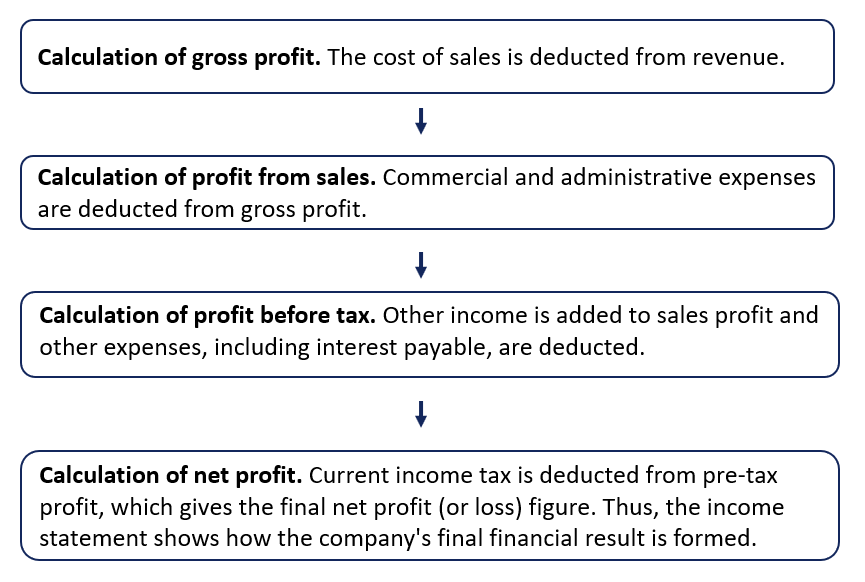
The income statement follows a step-by-step structure. Its purpose is to show how a company’s financial results are calculated — starting with total revenue and ending with net income. This format makes it easy to see how different types of income and expenses affect the company’s overall profitability at each stage.
In simple terms, the structure of the income statement can be viewed as a series of steps:
The income statement follows a step-by-step structure. Its purpose is to show how a company’s financial results are calculated — starting with total revenue and ending with net income. This format makes it easy to see how different types of income and expenses affect the company’s overall profitability at each stage.
In simple terms, the structure of the income statement can be viewed as a series of steps:
Criteria for Recognizing Revenue and Expenses
Accurate preparation of the income statement requires following the core principles of revenue and expense recognition. Under the accrual basis of accounting, transactions are recorded when they occur, not when cash is received or paid.
Key Recognition Criteria
For Revenue: Revenue is recognized not when an advance payment is received, but when the company has fulfilled its obligations to the customer — for example, by delivering the product or completing the contracted work. The key criterion is the completion of the performance obligation.
For Expenses: Expenses are recognized in the same reporting period as the revenues they help generate — this is known as the matching principle.
Accurate preparation of the income statement requires following the core principles of revenue and expense recognition. Under the accrual basis of accounting, transactions are recorded when they occur, not when cash is received or paid.
Key Recognition Criteria
For Revenue: Revenue is recognized not when an advance payment is received, but when the company has fulfilled its obligations to the customer — for example, by delivering the product or completing the contracted work. The key criterion is the completion of the performance obligation.
For Expenses: Expenses are recognized in the same reporting period as the revenues they help generate — this is known as the matching principle.
Example
In December 2024, a construction company received an advance payment for a project. However, the work wasn’t completed until February 2025. Even though the cash came in during 2024, the revenue wasn’t recognized that year. All related expenses — including materials and labor — were also recorded in February 2025, when the revenue was officially recognized. This approach ensured that the company’s financial statements accurately reflected the project’s true profit before taxes and net income for the correct reporting period.
In December 2024, a construction company received an advance payment for a project. However, the work wasn’t completed until February 2025. Even though the cash came in during 2024, the revenue wasn’t recognized that year. All related expenses — including materials and labor — were also recorded in February 2025, when the revenue was officially recognized. This approach ensured that the company’s financial statements accurately reflected the project’s true profit before taxes and net income for the correct reporting period.
How Cost of Sales, Selling, and Administrative Expenses Are Reflected in the Income Statement
The cost of sales, selling expenses, and administrative expenses are recorded in the same period as the revenue generated from the sale of goods or services.
Cost of Sales (Cost of Goods Sold, or COGS) includes all direct costs related to producing or purchasing the goods sold — such as raw materials, production labor, and depreciation of production equipment.
Selling Expenses are costs related to marketing and distributing products, including advertising, promotions, shipping, and sales team salaries.
Administrative Expenses represent the general operating costs of running the business — such as executive salaries, office rent, utilities, communication services, and depreciation of office equipment.
Calculating and Presenting Operating Profit
The calculation of operating profit (or loss) shows how much the company earned from its core business activities. This helps owners and managers evaluate overall efficiency and profitability.
Here’s how the process works:
This step-by-step calculation highlights how the company’s main operations contribute to its overall financial results.
The cost of sales, selling expenses, and administrative expenses are recorded in the same period as the revenue generated from the sale of goods or services.
Cost of Sales (Cost of Goods Sold, or COGS) includes all direct costs related to producing or purchasing the goods sold — such as raw materials, production labor, and depreciation of production equipment.
Selling Expenses are costs related to marketing and distributing products, including advertising, promotions, shipping, and sales team salaries.
Administrative Expenses represent the general operating costs of running the business — such as executive salaries, office rent, utilities, communication services, and depreciation of office equipment.
Calculating and Presenting Operating Profit
The calculation of operating profit (or loss) shows how much the company earned from its core business activities. This helps owners and managers evaluate overall efficiency and profitability.
Here’s how the process works:
- Revenue – Cost of Sales = Gross Profit (or Gross Loss)
- Gross Profit – Selling and Administrative Expenses = Operating Profit (or Operating Loss)
This step-by-step calculation highlights how the company’s main operations contribute to its overall financial results.
Example
For the 2025 reporting period, a manufacturer of case furniture reported $850 million in revenue. The cost of goods sold — including raw materials and production labor — totaled $520 million, resulting in a gross profit of $330 million. After deducting selling expenses for advertising and logistics ($45 million) and administrative expenses ($75 million), the company’s operating profit — reflecting the result of its core business activities — was $210 million.
For the 2025 reporting period, a manufacturer of case furniture reported $850 million in revenue. The cost of goods sold — including raw materials and production labor — totaled $520 million, resulting in a gross profit of $330 million. After deducting selling expenses for advertising and logistics ($45 million) and administrative expenses ($75 million), the company’s operating profit — reflecting the result of its core business activities — was $210 million.
Key Considerations When Preparing Financial Reports
Ensuring accuracy in your financial reporting is essential for reliable information that supports management decisions.
Important points to keep in mind:
Ensuring accuracy in your financial reporting is essential for reliable information that supports management decisions.
Important points to keep in mind:
- Follow Accounting Policies Closely. All transactions should be recorded according to your company’s established accounting policies.
- Timely Period Recognition. Revenues and expenses must be recorded in the correct reporting period.
- Adjustments and Revaluations. Account for currency fluctuations, revaluation of long-term assets, and create allowances where needed, such as for doubtful accounts.
- Tax Obligations. Income tax should be calculated based on the tax base, not on advance payments already made.
- Transparency and Disclosures. Provide explanations for significant items or unusual transactions to give users a clear understanding of the financial statements.
Example
The accounting team at a manufacturing company faced a significant currency exchange loss due to a foreign-currency loan. Instead of recording this loss as part of operating expenses, the accountant correctly classified it under other expenses.
This approach helped maintain a clear view of the company’s core operating results and provided owners with an accurate picture of business performance, separating operational efficiency from financial risk.
The accounting team at a manufacturing company faced a significant currency exchange loss due to a foreign-currency loan. Instead of recording this loss as part of operating expenses, the accountant correctly classified it under other expenses.
This approach helped maintain a clear view of the company’s core operating results and provided owners with an accurate picture of business performance, separating operational efficiency from financial risk.